Ephesus & Pamukkale 2 Days by Plane
Two-day Ephesus and Pamukkale tour by plane from Istanbul: the Library of Celsus and the House...
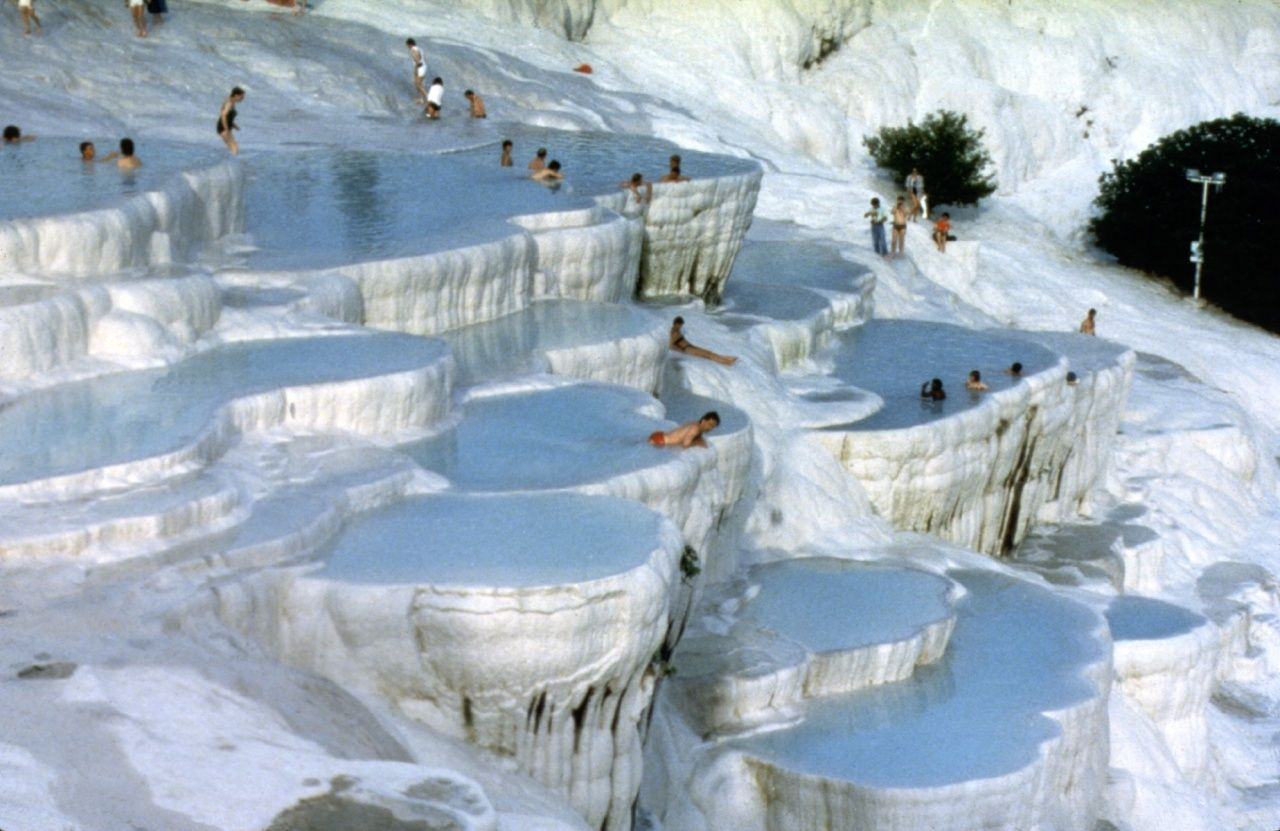
Cotton Castle and Healing Travertines
The nearest airport to Pamukkale is Denizli Cardak (DNZ, 65 km) with 3–4 flights a day from Istanbul. Alternatively it is 3 hours by road from Izmir, 3.5 from Antalya and 3 from Ephesus. Hotels with thermal pools are found in Pamukkale village and Karahayit; Karahayit's red-water springs are quieter for families. Entering from the south gate and walking up the travertines is less tiring than entering from the north gate and walking down.
The travertines are white terraces formed over millennia by calcium-rich hot water; to protect them you walk barefoot only and bathe only in designated pools. Ancient Hierapolis on the hilltop holds a 12,000-seat theatre, Roman baths and a necropolis of 1,200 tombs. In Cleopatra's Antique Pool you swim in 36°C thermal water among toppled Roman columns; it needs a separate ticket and modest swimwear is allowed. The terraces turning pink at sunset is the best photo moment.
Family tips: the water on the travertines is warm but the surface is rough; non-slip swim socks help small children. Summer reaches 38°C with no shade, so go at 08:00 or after 17:00. Bring a towel, swimwear and a change of clothes; lockers are at the entrance. There are cafes inside the site, but eating in the village is cheaper. Nearby ancient Laodicea (10 km) is a crowd-free, free-entry extra stop.
Denizli is a growing industrial city in the south-western part of Türkiye, at the eastern end of the alluvial valley formed by the river Buyuk Menderes, where the plain reaches an elevation of about a hundred metres, in the country's Aegean Region. Denizli has achieved remarkable economic development in the last decades based notably on textile production and exports, and is frequently cited as one of the foremost examples of the "Anatolian Tigers". Denizli attracts many visitors to the nearby mineral-coated hillside hot spring of Pamukkale and to the red-coloured thermal water spa hotels of Karahayit, just 5 km north of Pamukkale; it has become a major domestic tourism destination thanks to the various thermal waters in Saraykoy, Karahayit and Pamukkale, Akkoy (Golemezli), Buldan (Yenicekent) and Cardak. The ancient ruined city of Hierapolis, the ruins of Laodicea on the Lycus, the ancient metropolis of Phrygia, and, in the district of Honaz about 10 miles west of Denizli, the 1st-century AD city of Colossae are all here. The weather is hot in summer; in winter it may occasionally be very cold with snow on the surrounding mountains, and some years snow is seen in the urban areas; springs and autumns are rainy and mild. The area has been occupied since prehistoric times, and the important ancient Greek and Roman towns nearby (Hierapolis and Laodicea) persisted through the Byzantine period. In the 17th century the Turkish traveller Evliya Celebi recorded that the city is called Denizli ("seaside") because of the several rivers and lakes around it, that its square fortress had four gates, and that the main city outside the fortress had 44 districts, 3,600 houses, 57 mosques and masjids, 7 madrasahs, 6 baths and 17 dervish lodges.
Two-day Ephesus and Pamukkale tour by plane from Istanbul: the Library of Celsus and the House...
Three-day Ephesus, Pergamon and Pamukkale tour by plane from Istanbul: guided visits, entrance...
Pamukkale day trip from Istanbul by plane: walk barefoot on the white travertine terraces...